The Deferred Execution Trap Behind IQueryable in .NET
Some of the most damaging performance problems in .NET applications hide behind two interfaces that look almost interchangeable: IEnumerable and IQueryable. A query written against one runs efficiently in the database; the same-looking query against the other quietly pulls an entire table into memory and filters it there. The difference is invisible in the syntax and catastrophic in production, and it is compounded by deferred execution — the fact that a query often does not run when you think it does. Understanding these two concepts is the difference between .NET data code that scales and code that mysteriously crawls.
Two interfaces that look the same and are not
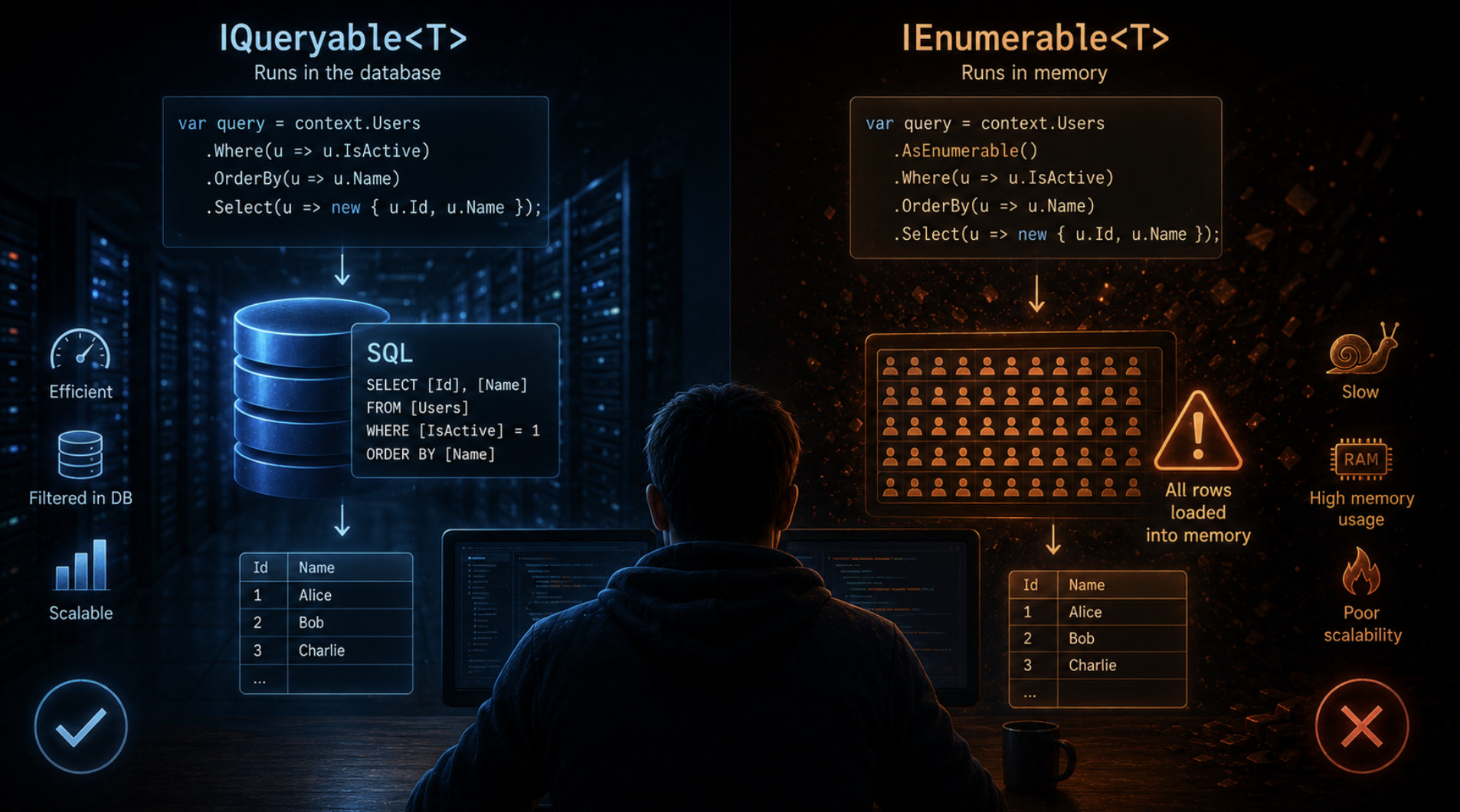
At first glance, IEnumerable and IQueryable appear to offer the same thing: a sequence you can filter, sort, and project with the same familiar query operators. You can write what looks like identical code against either. But underneath, they represent fundamentally different things, and the distinction determines where your query actually executes. IEnumerable represents a sequence that is queried in memory, with the operations performed by .NET on objects already loaded. IQueryable represents a query that can be translated into another form — most importantly, into database SQL — and executed by the data source itself.
This is the crux. When you build a query against IQueryable, the operations you chain are not executed immediately in memory; they are recorded and, when the query runs, translated into a query the database executes, returning only the results. When you build the same query against IEnumerable, the operations run in memory on whatever data has already been loaded. The same LINQ expression, therefore, can mean "ask the database to filter" or "load everything and filter in the application," depending solely on which interface it is operating over. The code looks identical; the behaviour could not be more different.
The performance cliff
The practical consequence of confusing the two is a performance cliff that is easy to fall off and hard to see. Imagine a query that filters a large table down to a few rows. Written against IQueryable, that filter is translated to SQL, the database does the work, and only the few matching rows travel back to the application — efficient and scalable. Written against IEnumerable, or accidentally switched to it partway through, the filter runs in memory, which means the entire table must first be loaded into the application before the filtering happens. The database sends everything; the application throws most of it away.
The insidious part is that this often works fine in development, where the table is small, and fails only in production, where the table is large. A query that pulled ten rows during testing pulls ten million in production, exhausting memory and grinding to a halt, with no change to the code that would suggest why. The switch from IQueryable to IEnumerable can happen without the developer noticing — calling a method that returns IEnumerable, materialising a query too early, or applying an operation the query provider cannot translate. Recognising when a query silently drops from database execution to in-memory execution is one of the most valuable skills in .NET data access, precisely because the failure is invisible until scale exposes it.
Deferred execution and when a query actually runs
Layered on top of this is deferred execution, a behaviour that surprises developers who assume a query runs when they write it. In fact, building a query — chaining filters and projections — usually does not execute anything. The query is a description of what to do, not the doing of it. Execution is deferred until the results are actually needed, which happens when you enumerate the query: iterating over it, or calling an operation that forces materialisation, such as converting it to a list or counting it.
This deferral is powerful but treacherous if misunderstood. It means you can compose a query in stages, adding conditions, without any database round-trip until the moment you consume the results — efficient, because the final query runs once, fully formed. But it also means the timing of execution is not where the code appears to run, which leads to subtle bugs: a query enumerated multiple times executes multiple times, hitting the database repeatedly; a query built over a changing variable captures the variable's later value; a query passed around unexecuted runs at an unexpected moment. Knowing exactly when a query materialises, and ensuring it happens once, where intended, is essential to both correctness and performance.
The multiple-enumeration trap
A specific and common bug born from deferred execution is enumerating the same query more than once. Because a deferred query re-executes each time it is enumerated, iterating over it in one place and then again in another does not reuse the results — it runs the whole query again, and against a database, that means a second expensive round-trip for data you already had. Tools and reviewers flag "possible multiple enumeration" precisely because it is such an easy and costly mistake.
The fix is to be deliberate about materialisation. When you know you need the results and will use them more than once, force the query to execute once by materialising it into a concrete collection, and then work with that collection in memory. When you are still composing the query and want the database to do the final work, keep it deferred and enumerate it exactly once at the end. The error is treating a deferred query as if it were an already-computed collection, using it repeatedly and paying the execution cost each time. Understanding that a query is a recipe, not a result, until materialised is what prevents this quiet multiplication of database work.
Writing data code that scales
Bringing these ideas together yields a set of habits that keep .NET data access efficient. Keep queries as IQueryable for as long as you want the database to do the work, applying filters, sorting, and projections that the query provider can translate into SQL, so that only the data you need crosses the wire. Be conscious of the moment a query drops to IEnumerable and runs in memory, and ensure it happens intentionally rather than by accident. Materialise a query once, at the point you actually need the results, and avoid enumerating it repeatedly.
Underlying all of this is a single principle: know where your query is running. The most damaging data-access bugs come from a query executing somewhere other than where the developer assumed — in memory instead of the database, multiple times instead of once, at an unexpected moment instead of the intended one. Cultivating an awareness of where and when execution happens, rather than trusting that identical-looking code behaves identically, is what separates data code that scales gracefully from code that collapses under production load. This attention to how abstractions actually behave at runtime is the same discipline that underlies robust application design more broadly, including choices like those in building maintainable applications with clean architecture.
Conclusion
IEnumerable and IQueryable look alike and behave in fundamentally different ways, and confusing them is one of the most common causes of hidden performance disasters in .NET. IQueryable pushes work to the database and returns only what is needed; IEnumerable runs in memory on already-loaded data, and a query that silently switches between them can turn an efficient filter into a full-table load that fails only at scale. Deferred execution compounds this by decoupling when a query runs from where it is written, producing multiple-enumeration bugs and surprising timing unless the developer knows exactly when materialisation occurs. The remedy is awareness and discipline: keep queries translatable and deferred while you want the database to work, materialise once at the point of need, and always know where and when your query is executing. Master these two concepts, and a whole category of invisible, scale-dependent failures simply disappears from your applications.