The Middleware Pipeline That Shapes Every ASP.NET Core Request
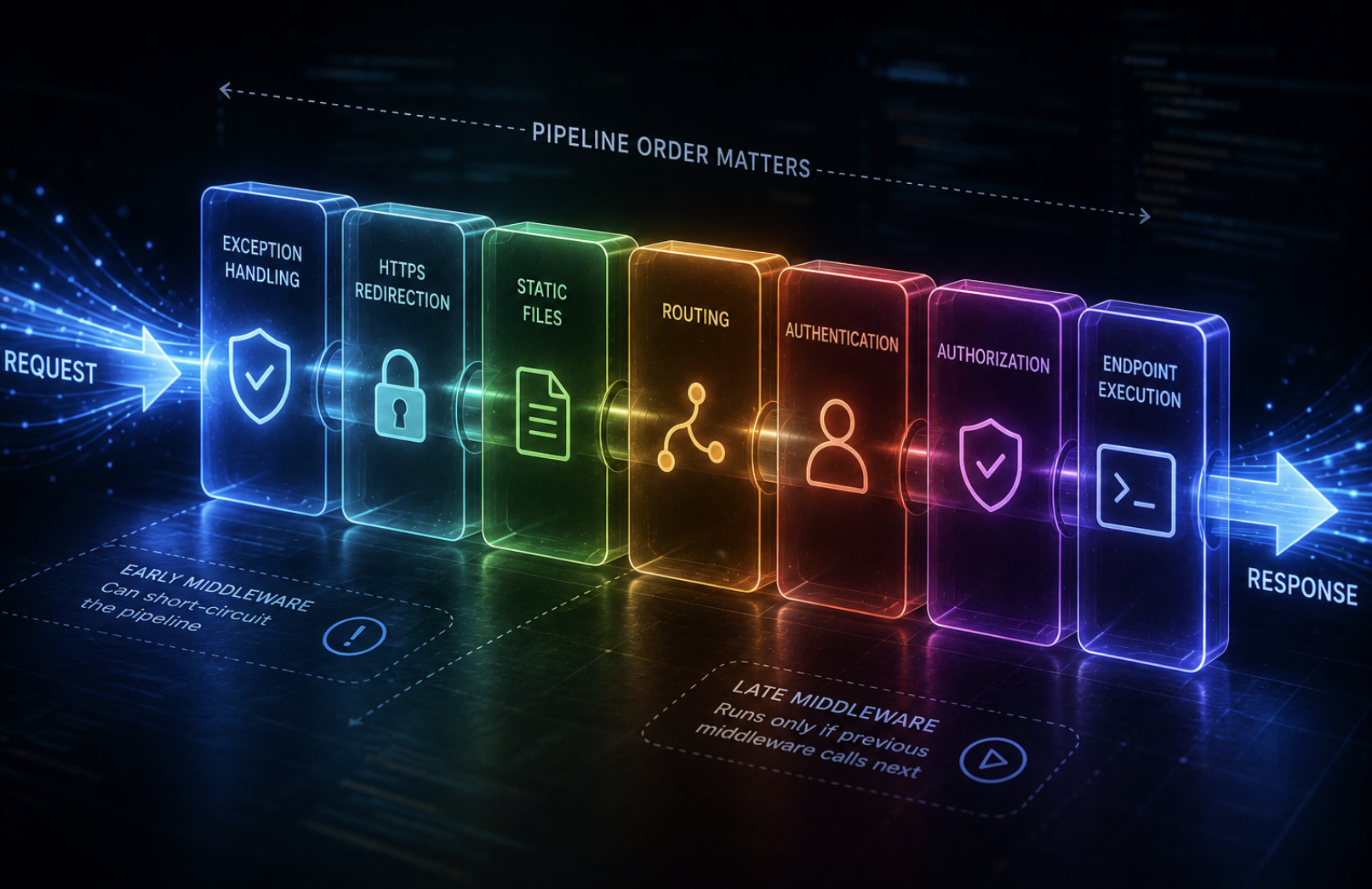
Every request that enters an ASP.NET Core application passes through a pipeline of middleware before a response returns, and yet many developers treat this pipeline as boilerplate — a block of configuration copied and rarely understood. That is a mistake, because the middleware pipeline is where authentication, error handling, routing, and much of an application's cross-cutting behaviour actually live, and its order determines whether all of it works correctly. Understanding how the pipeline is structured, and why sequence is decisive, is fundamental to building ASP.NET Core applications that behave the way you intend.
What the pipeline actually is
At its heart, the ASP.NET Core request pipeline is a chain of components, each of which can inspect and act on a request on its way in, pass it along to the next component, and then inspect and act on the response on its way back out. Each middleware component receives the request, does whatever it does — logging, authentication, adding headers, handling errors — and then either passes control to the next component in the chain or short-circuits, producing a response itself and stopping the request from going further.
The mental model that makes this clear is a series of nested wrappers, or an onion. A request travels inward through each layer of middleware until it reaches the core that generates a response, and then the response travels back outward through the same layers in reverse. This means each middleware component has two moments to act: once as the request passes in, and once as the response passes back out. Grasping this in-and-out flow is the foundation for reasoning about the pipeline, because it explains why the position of a component determines both when it sees the request and when it sees the response.
Order is everything
The single most important fact about the middleware pipeline is that the order in which components are added is the order in which they execute, and that order is not a detail — it is decisive. Because each middleware wraps the ones added after it, a component's position determines what it can see and do. Middleware added early sees the request first and the response last; middleware added late sees the request last and the response first. Get the order wrong, and the pipeline can behave in ways that range from subtly incorrect to completely broken.
Concrete examples make the stakes clear. Authentication must run before the middleware that depends on knowing who the user is, or that later middleware will make decisions without the identity it needs. Error-handling middleware must be positioned so that it wraps the components whose errors it is meant to catch, which generally means placing it early, near the outside of the onion, so that exceptions thrown deeper inside bubble back out to it. Routing must occur before the middleware that acts on the matched route. Each of these is a matter of sequence, and each is a common source of bugs when the order is wrong. The pipeline does exactly what its order tells it to, which is why understanding that order is not optional.
Short-circuiting and the terminal middleware
A key capability of middleware is the ability to short-circuit — to stop processing the request and produce a response without passing control further down the chain. This is not a flaw but a feature, and it is how a great deal of important behaviour works. Authentication middleware that finds an unauthorised request can reject it immediately, without letting it reach the application logic; caching middleware can return a cached response without doing the work again; a component can respond to a specific request entirely on its own.
Understanding short-circuiting clarifies why order matters even more. When a middleware short-circuits, everything after it in the pipeline never runs for that request, because control never reaches it. This means a component placed after a short-circuiting one may be silently skipped in exactly the cases where the earlier component acts. The pipeline typically ends with terminal middleware — the endpoint that actually handles the request and generates the primary response — and everything before it exists to inspect, modify, guard, or short-circuit the request on its way to that endpoint. Knowing which components can short-circuit, and where they sit relative to the components that must always run, is essential to a pipeline that behaves correctly.
Writing custom middleware
Beyond the built-in components, ASP.NET Core lets you write custom middleware to inject your own cross-cutting behaviour into the pipeline, and this is where the model's flexibility shows. Custom middleware fits the same pattern: it receives the request, does its work, and then either calls the next component or short-circuits. This is the natural home for concerns that apply across many requests — custom logging, request enrichment, specialised headers, bespoke error handling — that do not belong in individual endpoint logic.
The value of placing such concerns in middleware, rather than scattering them through the application, is that the pipeline centralises cross-cutting behaviour in one clear, ordered place. A concern implemented as middleware runs consistently for every request that passes through it, without being repeated in each handler, which keeps the endpoint logic focused on its actual job. This separation of cross-cutting concerns from core logic is a hallmark of well-structured applications, the same principle that motivates careful architecture throughout a system, as discussed in building maintainable applications with clean architecture. Middleware is the pipeline's mechanism for that separation, and using it well keeps an application both organised and predictable.
The mistakes that break the pipeline
Because the pipeline is governed by order and flow, the mistakes that break it tend to be mistakes of sequence and understanding rather than of syntax. Placing middleware in the wrong order is the most common: error handling too late to catch the errors it should, authentication after the code that needs the identity, a short-circuiting component before one that was supposed to run. Each produces behaviour that is hard to diagnose precisely because the code looks correct — the components are all present, merely in the wrong sequence.
Another class of mistake comes from misunderstanding the in-and-out flow: expecting middleware to act on a response when it was positioned to act only on the request, or failing to account for the fact that response-side logic runs in reverse order. And forgetting that a short-circuit skips everything after it leads to components that mysteriously do not run in certain cases. The remedy for all of these is the same: understand the pipeline as an ordered, two-directional flow of wrappers, and place each component deliberately according to what it needs to see and when. The pipeline is not boilerplate to be copied; it is a precise structure whose order encodes behaviour, and treating it that way is what makes an application's request handling correct and predictable.
Conclusion
The middleware pipeline is the backbone of every ASP.NET Core application, the ordered chain through which every request and response flows, and where authentication, error handling, routing, and cross-cutting behaviour actually operate. Understanding it means understanding the in-and-out flow of nested wrappers, in which each component sees the request on the way in and the response on the way out, and in which the order of registration determines everything a component can do. Short-circuiting lets components halt a request and skip the rest of the pipeline, making sequence matter still more, and custom middleware provides a clean, centralised home for concerns that span many requests. The bugs that afflict the pipeline are overwhelmingly bugs of order and flow, not syntax, and they are avoided by treating the pipeline as the deliberate, meaningful structure it is rather than as configuration to be pasted and ignored. Master the pipeline's order and flow, and you master how an ASP.NET Core application handles everything that reaches it.